
Table of Contents
Oman is an Arabian nation of dramatic contrasts, where rugged mountains rise above turquoise wadis, desert dunes stretch toward the Empty Quarter, and a monsoon turns the far south green each summer. Its position beside the Arabian Sea and the Strait of Hormuz has connected Oman with Africa, India, and the wider world for thousands of years.
In this article, we’ll explore 50 fun facts about Oman covering its geography, plants and wildlife, culture, government and economy, and history. Along the way, you’ll discover an enclave inside another enclave, ancient irrigation channels, rare Arabian leopards, an isolated whale population, underground feasts, Bronze Age tombs, and an Omani trading empire that once reached Zanzibar.
Oman Fast Facts
| Official Name | Sultanate of Oman |
| Form of Government | Hereditary Monarchy |
| Capital | Muscat |
| Population | 5.43 million (2026) |
| Official Language | Arabic |
| Money | Omani Rial (OMR) |
| Area | 309,500 square kilometers (120,000 square miles) |
| Major Mountain Ranges | Al Hajar Mountains and Dhofar Mountains |
| Major Rivers | No permanent rivers; seasonal waterways are known as wadis |
| Country Code | +968 |
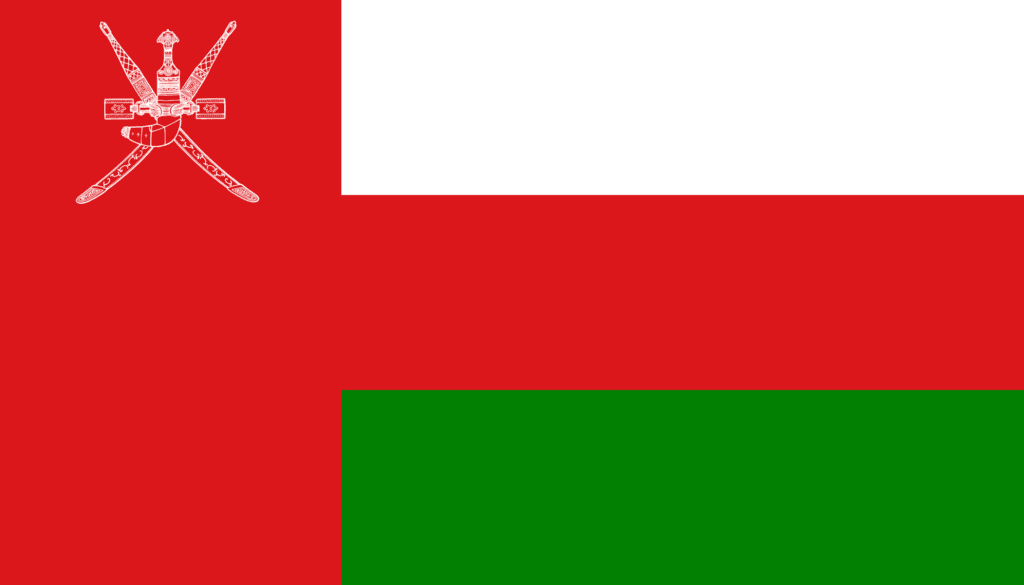
Oman Flag
Oman Interesting Facts: Geography
1.Oman Is the Third-Largest Country on the Arabian Peninsula – Oman covers approximately 309,500 square kilometers (120,000 square miles), making it larger than the United Kingdom. Only Saudi Arabia and Yemen occupy more land on the peninsula, although much of Oman’s interior consists of sparsely populated desert and gravel plains.
2. Two Pieces of Oman Are Separated From the Mainland by the United Arab Emirates – The mountainous Musandam Peninsula and the smaller territory of Madha are physically separated from Oman’s main landmass. Traveling to either by road from mainland Oman requires crossing the United Arab Emirates, giving the country one of the Arabian Peninsula’s most unusual territorial layouts.
3. An Emirati Village Sits Inside an Omani Enclave Inside the UAE – Madha is an Omani enclave surrounded by the United Arab Emirates, but the geographic puzzle goes one step further. Inside Madha lies Nahwa, a small village belonging to the Emirate of Sharjah, creating a rare counter-enclave in which one country’s territory is enclosed inside an enclave of another.
4. Musandam’s Mountains Drop Into Fjord-Like Inlets Beside the Strait of Hormuz – At Oman’s northern tip, the Hajar Mountains plunge into narrow sea inlets locally called khors. These steep-sided waterways give Musandam its famous fjord-like scenery and place the peninsula beside the Strait of Hormuz, the narrow maritime passage connecting the Gulf with the Gulf of Oman.
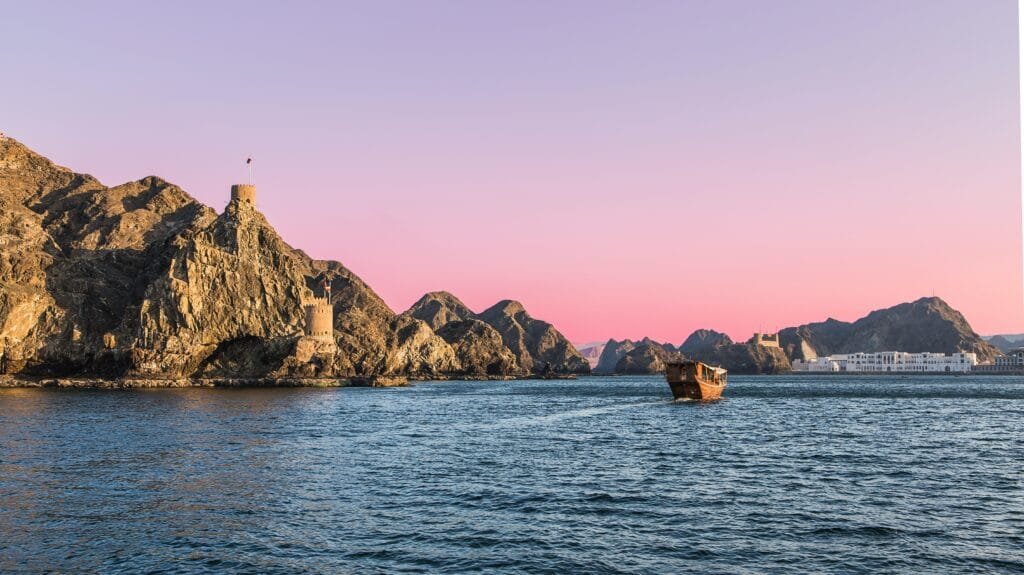
Küste, Oman
5. Jabal Shams Rises More Than 3,000 Meters Above Sea Level – Jabal Shams is Oman’s highest mountain, reaching approximately 3,009 meters (9,872 feet) in the western Hajar range. Its name means “Mountain of the Sun,” and the surrounding high plateau overlooks the immense Wadi an Nakhur gorge, often nicknamed the Grand Canyon of Oman.
6. Part of Oman’s Mountain Range Was Once Beneath an Ancient Ocean – The Hajar Mountains contain the Samail Ophiolite, one of the world’s largest and best-exposed sheets of ancient oceanic crust and upper mantle. These rocks formed roughly 95 million years ago and were later thrust onto the Arabian continental margin, allowing geologists to study material normally buried beneath the seafloor.
7. A Summer Monsoon Turns Southern Oman Green – From roughly June through September, seasonal monsoon winds known as the khareef bring cool mist and rain to Dhofar. Hills around Salalah that appear brown during much of the year become covered in green vegetation, while temporary waterfalls and flowing wadis emerge during the wet season.
8. The Empty Quarter Reaches Into Western Oman – Part of Rub’ al Khali, or the Empty Quarter, extends across Oman’s western interior. Shared with Saudi Arabia, Yemen, and the United Arab Emirates, this immense desert contains vast dune fields and some of the Arabian Peninsula’s most isolated landscapes.
9. Muscat Is Squeezed Between the Sea and the Mountains – Oman’s capital stretches along the Gulf of Oman with rocky mountains rising immediately behind many neighborhoods. Because level land is limited, the metropolitan area developed as a long chain of coastal communities rather than around a single compact center.
10. A Hidden Chamber Beneath Oman Is Large Enough to Swallow a City Block – Majlis al Jinn is a single underground chamber measuring roughly 310 by 225 meters, with a domed ceiling reaching about 120 meters high. Located beneath the remote Selma Plateau, it ranks among the world’s largest known cave chambers by floor area and can be entered only through openings in its roof.
Fun Facts about Oman: Plants and Wildlife
11. Five Species of Sea Turtle Occur Along Oman’s Coast – Oman’s long coastline supports green, loggerhead, hawksbill, olive ridley, and leatherback sea turtles. Nesting areas such as Ras al Hadd, Ras al Jinz, and Masirah Island make the country internationally important for turtle conservation across the northwestern Indian Ocean.
12. More Than 90% of Oman’s Loggerhead Nesting Occurs on Masirah Island – Surveys have found loggerhead turtles nesting on at least 178 Omani beaches, but Masirah Island supports the overwhelming majority of the country’s nests. Earlier research estimated tens of thousands of nesting females, although later monitoring revealed a serious long-term decline in this globally important population.
13. Blind Fish Live in the Darkness of Al Hoota Cave – A subterranean population of the Oman garra inhabits pools inside Al Hoota Cave in the Hajar Mountains. Unlike surface-dwelling members of the same species, the cave form lacks visible eyes and pigmentation, adaptations to life without sunlight. Scientists discovered the population in 1980 and continue to study its genetic connections with nearby surface fish.
14. Oman’s Humpback Whales Belong to an Isolated Population of Fewer Than 100 – Arabian Sea humpback whales do not make the long seasonal migrations typical of most humpback populations. Genetic and photographic research indicates that they are exceptionally isolated, and estimates based on whales identified off Oman suggest fewer than 100 individuals remain.
15. Fewer Than 100 Arabian Leopards May Survive in Oman’s Southern Mountains – The Arabian leopard is one of the smallest and rarest leopard subspecies. Oman’s Environment Authority reports that fewer than 100 remain in the country’s southern mountain habitat, where protected areas such as Jabal Samhan provide a refuge for this critically endangered predator.
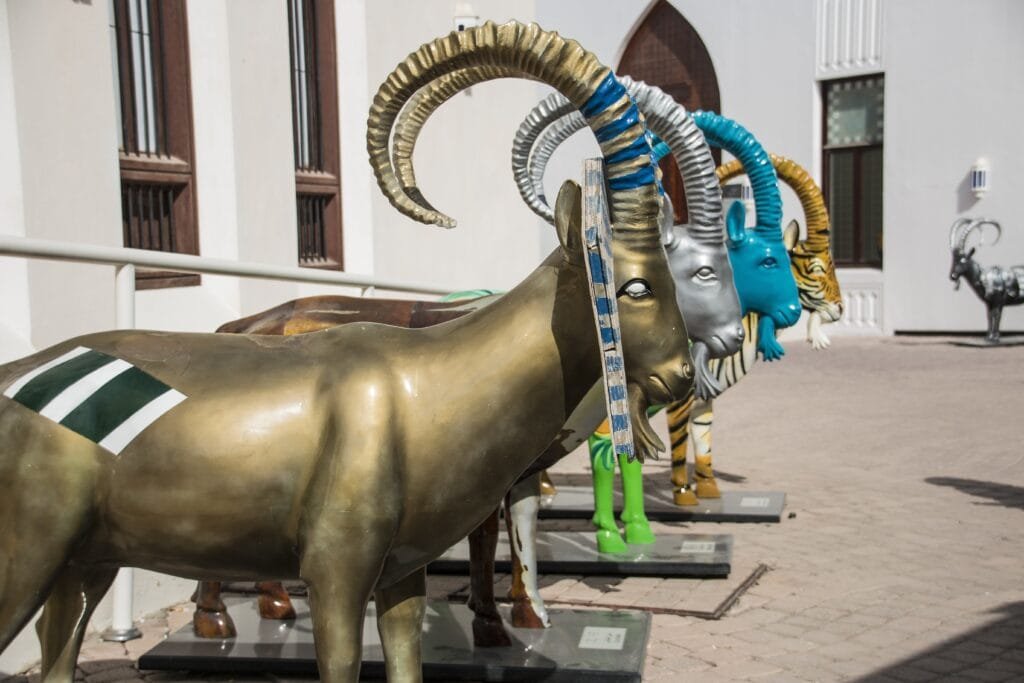
16. The Arabian Tahr Lives Nowhere Outside the Hajar Mountains – This stocky, sure-footed relative of goats occupies steep cliffs and rocky slopes in Oman and the neighboring United Arab Emirates. Its entire natural range is confined to the Hajar Mountains, making the survival of the species closely tied to the conservation of this single mountain system.
17. Arabian Oryx Returned to Oman a Decade After Vanishing From the Wild – The last known wild Arabian oryx was killed in Oman in 1972, leaving the species extinct outside captivity. Animals descended from an international breeding herd were released in Oman in 1982, beginning one of the world’s best-known efforts to restore a large mammal after extinction in the wild.
18. Frankincense Comes From Cuts Made in a Desert Tree’s Bark – Boswellia sacra trees grow in the dry landscapes of Dhofar, including Wadi Dawkah. Harvesters make careful incisions in the bark and collect the aromatic resin after it hardens, continuing a practice that supplied one of the ancient world’s most valuable luxury goods.
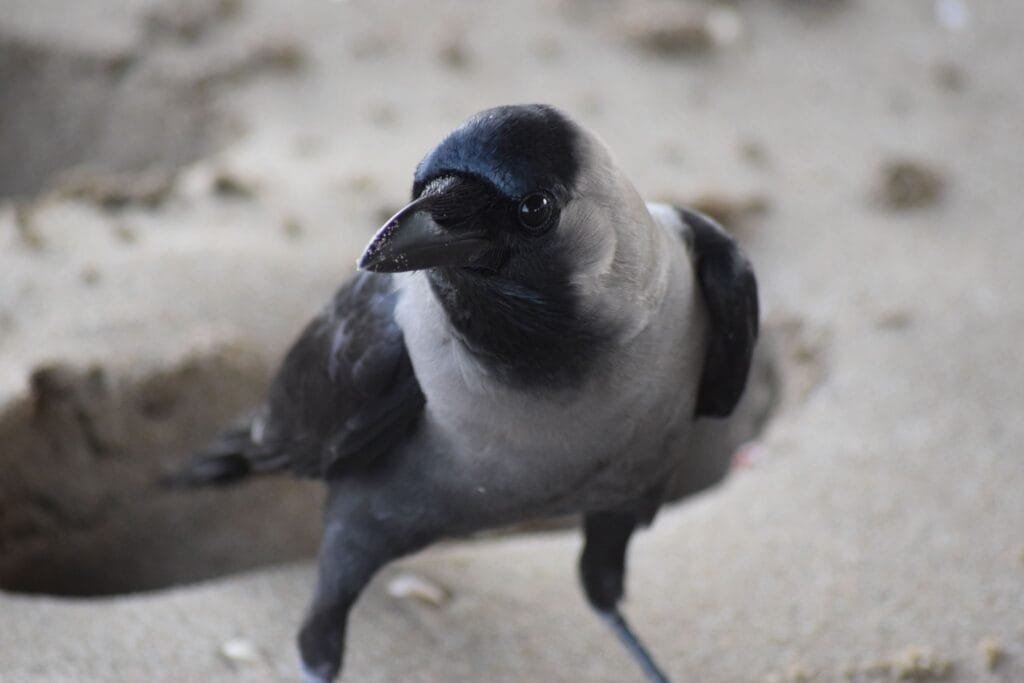
19. Masirah Island Supports an Unusually Dense Population of Egyptian Vultures – A 2012 survey recorded 53 breeding pairs of endangered Egyptian vultures on Masirah, far more than researchers expected. The finding placed the island among the world’s densest known breeding areas for the species, which is recognizable by its white plumage, black flight feathers, and bare yellow face.
20. A Coastal Peninsula Supports Coral Reefs Dominated by a Single Species – Bar al Hikman is a low-lying wetland and tidal landscape covering roughly 550 square kilometers on Oman’s Arabian Sea coast. Scientists have documented unusual coral reefs there dominated by a single coral species, alongside feeding grounds that can attract enormous concentrations of migratory shorebirds.
Cool Facts about Oman: Culture
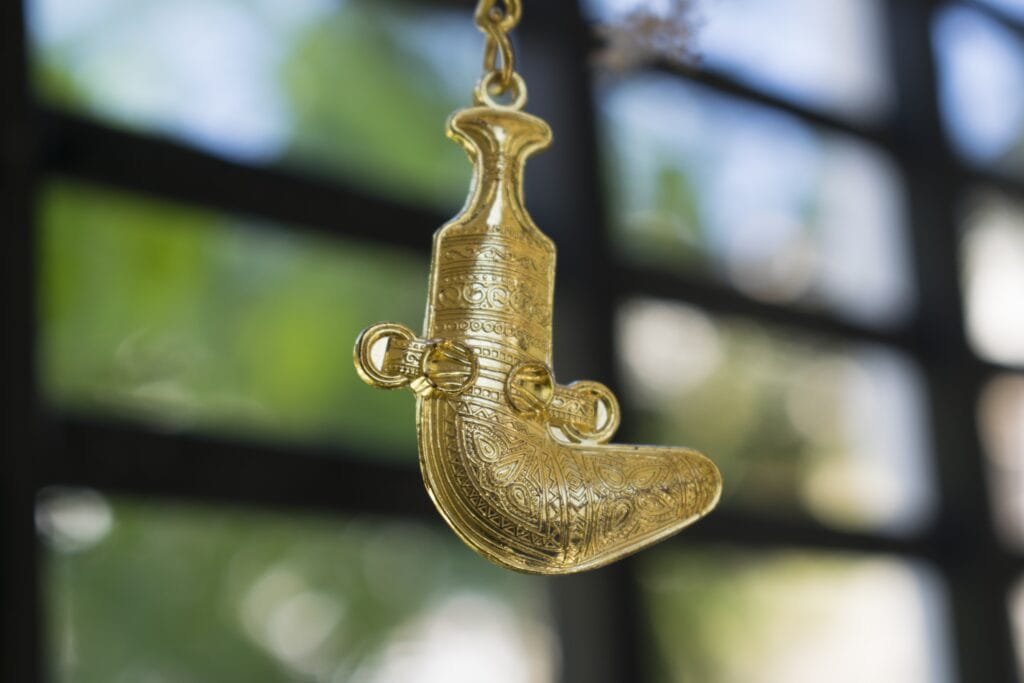
21. The Curved Khanjar Appears on Oman’s Flag and National Emblem – The khanjar is a traditional curved dagger worn by Omani men during weddings, religious celebrations, and national occasions. A sheathed khanjar over crossed swords has represented the ruling dynasty since the 18th century, and UNESCO recognized the dagger’s craft skills and social traditions in 2022.
22. Serving Coffee Is a Carefully Preserved Symbol of Generosity – Omani hospitality commonly begins with small cups of lightly roasted Arabic coffee accompanied by dates. The preparation, serving order, gestures, and social knowledge surrounding Arabic coffee are treated as a shared cultural tradition, and UNESCO recognizes the custom as intangible cultural heritage.
23. The Tassel on an Omani Dishdasha Can Be Scented With Perfume – Men’s traditional dress often includes an ankle-length, collarless robe known as a dishdasha. Near the neckline hangs a decorative tassel called a furakha, which may be perfumed so that a subtle fragrance follows the wearer.
24. About 3,000 Traditional Aflaj Still Carry Water Through Oman – Aflaj use gravity to channel water from springs or underground sources to homes and farms, sometimes across several kilometers. Water shares are traditionally measured by time and monitored with sundials, while five representative systems are protected together as a UNESCO World Heritage Site.
25. Omani Shuwa Can Cook Underground for an Entire Day or Longer – For major celebrations, seasoned lamb or goat may be wrapped in leaves, placed inside woven palm bags, and lowered into a communal underground oven. The sealed meat cooks slowly over hot coals for many hours, producing an exceptionally tender feast commonly associated with Eid and large family gatherings.
26. Mountain Villages Distill Rose Water in Copper Pots Each Spring – Roses bloom on Jabal Akhdar during March and April, when growers harvest the flowers early in the day. Traditional distillers heat petals with water in copper vessels, producing fragrant Omani rose water used in sweets, coffee, perfume, household hospitality, and religious occasions.
27. Oman’s Minority Languages Come From Three Different Language Families – Arabic is the official and most widely used language, but Oman’s linguistic landscape also includes Iranian languages such as Baluchi and Kumzari, Modern South Arabian languages such as Mehri and Shehri, and the Bantu language Swahili. The variety reflects centuries of movement and trade around the Indian Ocean.
28. A Village in Musandam Speaks Arabia’s Only Indigenous Iranian Language – Kumzari is spoken around Kumzar and neighboring communities near the Strait of Hormuz. Although surrounded by Arabic-speaking territory, its grammar is Iranian, while its vocabulary reflects long contact with Arabic and other trading languages.
29. Traditional Wooden Dhows Are Still Built in the City of Sur – Sur developed into one of Arabia’s great maritime and shipbuilding centers through its trade with India and East Africa. Craftspeople still construct wooden dhows there, preserving a living connection to the vessels that carried Omani sailors, merchants, dates, spices, and other goods across the Indian Ocean.
30. Omani Riders Perform Acrobatics on Galloping Horses and Camels – During the traditional Ardhah, riders may stand on moving animals, join hands with another rider at speed, or guide horses and camels into coordinated displays. The festival combines horsemanship, poetry, music, and community celebration, and UNESCO added the tradition to its Representative List in 2018.
Oman Facts: Government & Economy
31. Oman’s Sultan Is Both Head of State and Prime Minister – Oman is a hereditary monarchy led by Sultan Haitham bin Tarik, who succeeded Sultan Qaboos in January 2020. In addition to serving as head of state, he is prime minister and presides over the Council of Ministers, the country’s chief executive body.
32. Oman Created the Position of Crown Prince in 2021 – A new Basic Statute introduced a formal crown prince and clearer hereditary succession process. The change was significant because Oman previously relied on the ruling family to select a successor, with a sealed letter from the late sultan available if the family could not agree.
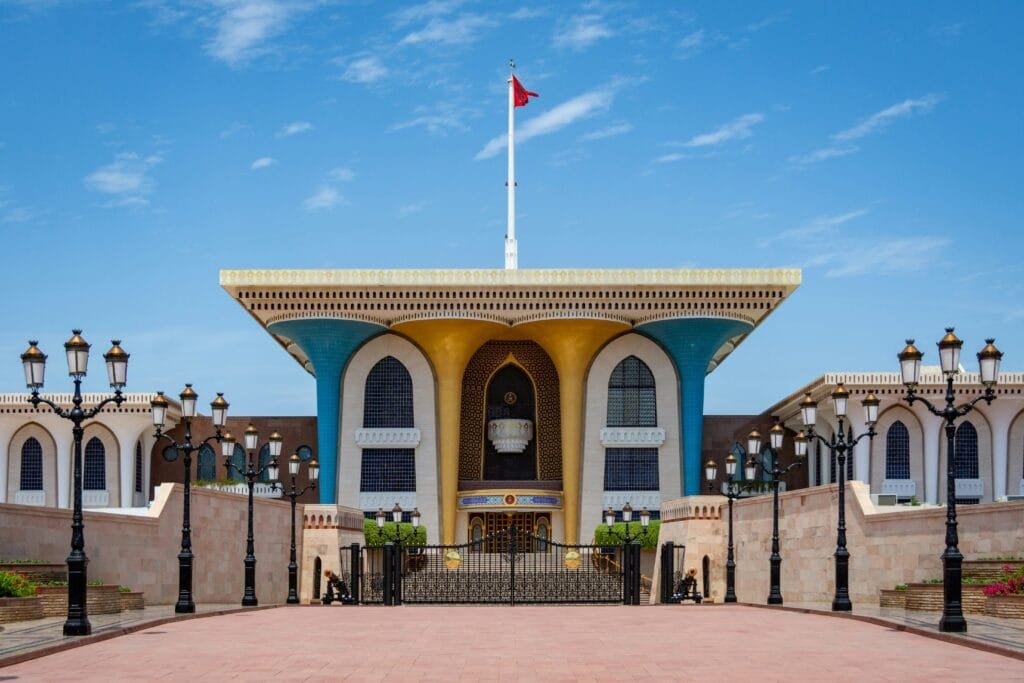
33. Oman’s National Legislature Has One Elected and One Appointed Chamber – The Council of Oman consists of the directly elected Majlis A’Shura and the appointed Majlis A’Dawla. The lower chamber has 90 members representing the country’s provinces, while the upper chamber has 86 experienced Omanis selected by royal decree.
34. Every Omani Citizen Over 21 Can Vote for the Shura Council – Men and women elect members of Majlis A’Shura by direct, secret ballot. The council reviews and proposes legislation, discusses development plans and the national budget, and can question government ministers, although bills require the sultan’s approval to become law.
35. One Omani Rial Is Divided Into 1,000 Baisas – Unlike currencies divided into 100 smaller units, Oman’s rial contains 1,000 baisas. The rial has been fixed at approximately US$2.6008 since 1986, making each individual rial worth more than two and a half U.S. dollars.
36. More Than Two Million People Living in Oman Are Expatriates – Official statistics recorded roughly 3.07 million Omanis and 2.36 million expatriates in 2026. Foreign residents therefore make up more than two-fifths of the population and play major roles in construction, retail, hospitality, health care, domestic work, and other parts of the economy.
37. Commercial Oil Production Transformed Oman After 1967 – Oil was discovered in commercial quantities during the 1960s, and exports began in 1967. Petroleum revenue later financed roads, schools, hospitals, utilities, and other infrastructure, while modern economic policy increasingly emphasizes tourism, logistics, manufacturing, fisheries, mining, and renewable energy.
38. Duqm Contains a 2,000-Square-Kilometer Economic Zone – The Special Economic Zone at Duqm spreads across approximately 2,000 square kilometers on Oman’s Arabian Sea coast. Built around a deepwater port and dry dock, the enormous development area is intended to attract logistics, manufacturing, energy, fisheries, tourism, and other industries beyond traditional oil production.
39. Oman Became the Fifth Middle Eastern Country to Sign a Free-Trade Agreement With the United States – The United States–Oman Free Trade Agreement entered into force on January 1, 2009. It immediately removed duties from virtually all industrial and consumer products traded between the two countries and created broader rules for services and investment.
40. Salalah’s Port Sits Beside a Major Shipping Route but Outside the Strait of Hormuz – The Port of Salalah lies directly beside the main east–west shipping lane linking Asia and Europe. Its Arabian Sea location avoids passage through the Strait of Hormuz, helping it serve as a major transshipment hub connecting the Middle East, the Indian subcontinent, and East Africa.
Oman History Facts
41. Ancient Mesopotamians May Have Known Oman as the Land of Magan – Cuneiform records describe Magan as an important source of copper traded with Mesopotamia during the Bronze Age. Archaeological evidence from Oman’s mines and settlements supports its identification as a core part of this copper-producing region, which was linked by sea with communities in present-day Iraq and the Indus Valley.
42. Oman Preserves the World’s Most Complete Collection of Third-Millennium BCE Settlements and Tombs – The archaeological sites of Bat, Al-Khutm, and Al-Ayn contain stone towers, settlements, workshops, and large cemeteries dating back 4,000 to 5,000 years. Their distinctive circular “beehive” tombs form one of the Arabian Peninsula’s most remarkable Bronze Age landscapes.
43. Frankincense Linked Southern Oman With Distant Civilizations for Centuries – Resin harvested in Dhofar traveled through fortified ports and desert caravan stations toward the Mediterranean, Mesopotamia, India, and China. The surviving trees at Wadi Dawkah and ruins at Shisr, Khor Rori, and Al-Baleed are now protected together as the UNESCO-listed Land of Frankincense.
44. Oman Embraced Islam During the Prophet Muhammad’s Lifetime – In the seventh century, Oman’s rulers accepted an invitation to join the new Muslim community. The country subsequently developed a distinctive Ibadi religious and political tradition while Omani sailors expanded commercial connections across the Indian Ocean.
45. Portugal Controlled Muscat for Nearly a Century and a Half – Portuguese forces seized Muscat in 1507 as part of an effort to dominate Indian Ocean trade routes. Omani forces eventually expelled them in 1650, a victory that helped launch Oman’s rise as a powerful maritime state.
46. The Dynasty Ruling Oman Today Began in the 18th Century – Ahmad ibn Said emerged during resistance to Persian occupation and was elected imam in the 1740s. He founded the Al Bu Said dynasty, whose descendants have governed Oman ever since, giving the country one of the world’s longest-continuing ruling houses.
47. Oman Once Ruled an Empire Extending to the Coast of East Africa – After driving the Portuguese from Muscat, Omani power spread across parts of the western Indian Ocean. By the 19th century, the empire controlled Zanzibar and important East African ports, creating lasting cultural, linguistic, and family connections between Oman and the Swahili coast.
48. Zanzibar Became the Center of the Omani Empire in the 19th Century – Sultan Said bin Sultan transferred his court to Zanzibar as the island grew wealthy from Indian Ocean commerce and clove plantations. After his death in 1856, the empire was divided between his sons, separating the Sultanate of Zanzibar from Muscat and Oman.
49. An Omani Ship Carried an Arab Diplomatic Mission to New York in 1840 – Seven years after Oman and the United States signed a Treaty of Amity and Commerce, the Omani vessel Sultana arrived in New York carrying envoy Ahmad bin Na’aman. The voyage marked an extraordinary early diplomatic connection between the United States and the Arab world.
50. Sultan Qaboos Began a New Era of Development in 1970 – Qaboos bin Said came to power while the Dhofar rebellion was still underway and Oman possessed limited modern infrastructure. After the insurgency ended in 1976, oil revenue supported rapid expansion of education, health care, roads, electricity, and government services during his nearly 50-year reign.